01 Regulating brain-wave activity
Research has looked at whether participants can learn to change certain EEG indicators through neurofeedback, with results depending on the protocol and study method.
Neurotherapy is a broad term for many training and care approaches related to the nervous system. One studied technique is EEG neurofeedback, which uses the brain's electrical activity as feedback during training.
A neurofeedback system records EEG signals from the scalp, processes the data according to the protocol, and shows it as images, sounds or on-screen activities so that participants learn to regulate their brain-signal patterns towards the training goals.
Some approaches use qEEG data from an assessment before training to help choose a protocol, but using qEEG does not mean training results can be predicted or effectiveness guaranteed.
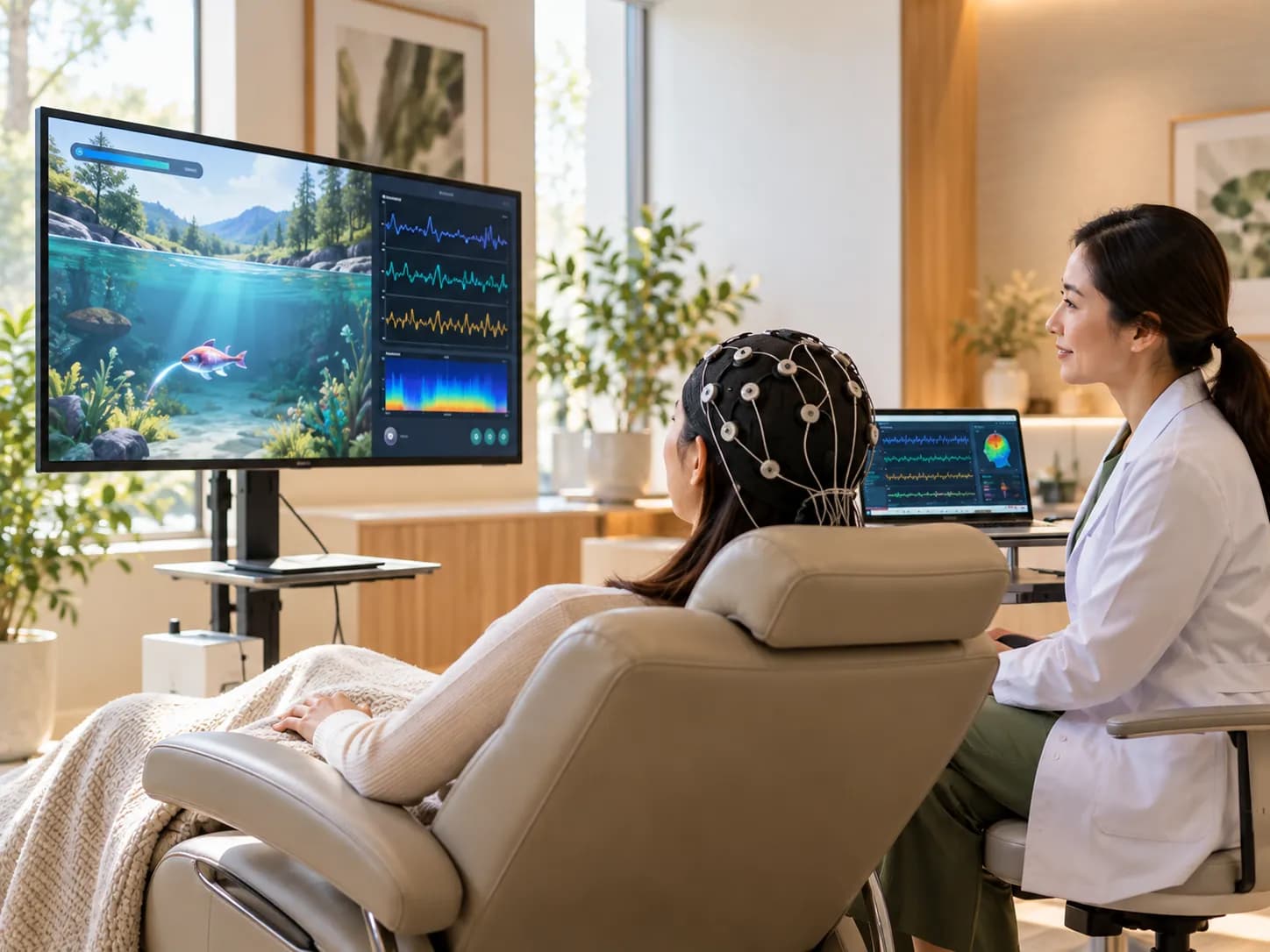
Learning through feedback from your own brain activity
EEG neurofeedback is based on learning through feedback: the system responds to the EEG signal patterns measured at that moment.
For example, a participant may watch an animation or on-screen activity that the system adjusts according to the conditions set in the protocol.
Participants can then learn the relationship between their own responses and the feedback they receive.
Record → Analyze → Feedback → Training → Monitor
EEG signals are recorded from the scalp with suitable sensors.
Signals are processed according to the indicators and conditions set in the protocol.
Real-time feedback is shown through images, sounds or on-screen activities.
Participants learn to respond to the feedback according to the training format.
Data is tracked during training and results related to each person's goals are assessed.
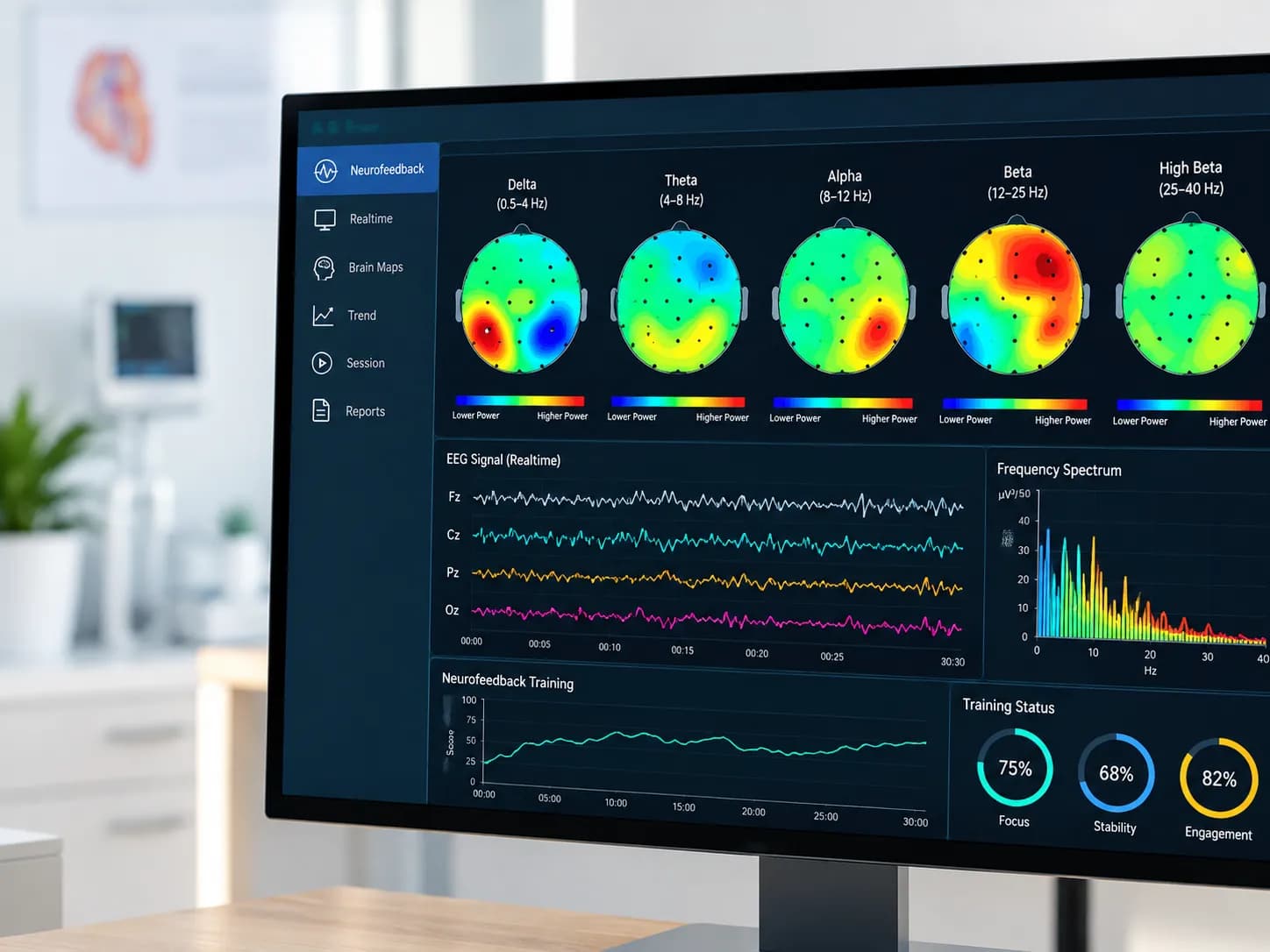
From brain-wave data to choosing a training approach
qEEG (quantitative electroencephalography) analyses EEG signals quantitatively — for example frequency, signal power or other features depending on the method.
This data may be used to help choose the neurofeedback training format in some protocols.
However, qEEG cannot identify with certainty the best training protocol for everyone, and the training approach should be chosen together with history, symptoms, goals and scientific evidence.
Research has looked at whether participants can learn to change certain EEG indicators through neurofeedback, with results depending on the protocol and study method.
Neurofeedback has been studied in people with attention problems, including ADHD, but large reviews have not found clear enough evidence to use it consistently as a stand-alone treatment.
Neurofeedback has been studied in people with sleep problems, but controlled trials have not confirmed a specific benefit over sham training in some studies.
Neurofeedback research studies the learning involved in regulating brain signals. However, changes in EEG signals do not always mean memory, attention or everyday abilities improve.
A consultation may suit people who
Having brain fog, reduced memory or stress does not automatically mean neurofeedback is needed — the cause of the symptoms should be assessed first.
We take your health history, symptoms, medication and care goals to assess whether training is appropriate.
We review relevant data, including EEG or qEEG where indicated, without using test results alone to diagnose.
We choose a training format based on your goals and health data, explaining expected benefits, limitations and uncertainty of results.
Training is carried out with feedback from EEG signals according to the chosen protocol.
We track your response during training and assess changes in symptoms or related goals.
We review the training results and consider whether continued care is appropriate.
Records and analyses the brain's electrical activity to provide data that supports assessment where indicated.
Uses EEG signals measured during training to create feedback, so participants learn to regulate signal patterns according to the protocol.
The two technologies have different purposes, and having an EEG does not mean you always need neurofeedback.
Neurotherapy is a broad term covering many techniques; EEG neurofeedback is one training method that uses EEG signals as feedback.
Typical EEG neurofeedback only receives electrical signals from the scalp — it does not send current into the brain.
There is not yet enough evidence that EEG neurofeedback can treat brain fog in general. The cause of the symptom should be assessed before choosing an approach.
The number depends on the protocol and training goals. There is currently no standard number of sessions that guarantees results for everyone.
Some protocols use qEEG data to help decide, but there is not enough evidence to guarantee that choosing a protocol from qEEG gives better results than other methods in every case.
At ZENITH Neuro Wellness we focus on each person's health assessment and goals to decide whether neurotherapy and EEG neurofeedback are appropriate. Start with a consultation to understand the training format, expected benefits and the limits of the technology.